
miércoles, 29 de diciembre de 2010

domingo, 28 de noviembre de 2010

miércoles, 17 de noviembre de 2010
FESTOS
Interesante proyecto a investigar: Festos. La ciencia-ficción aplicada a la versión política realidad. Este proyecto plantea el desarrollo tecnológico futuro para prevenir futuros riesgos tecnológicos. Jugar al "¿Y si se consiguiera...?" o "¿Y si se descubriera...?" en base a todos los proyectos que están en marcha con una fecha tope de objetivo 2030. ¿Puede este proyecto ser (digamos por plantearlo de alguna forma) éticamente razonable? Dentro de unos límites de la ética occidental al uso. No olvidemos que en términos políticos hablamos de ciencia-ficcion.
¿Y si en base a este proyecto se están vetando líneas de investigación futuras, se implanta una censura preventiva de las ideas?
¿Y si en base a este proyecto se asumen cuales son las líneas de investigación tecnológicas más potencialmente peligrosas para deducir que son efectivamente las más interesantes, potenciándolas?
¿No es una tremenda gilipollez que se destinen a esto los fondos del séptimo programa marco?
Como friki que soy seguiré sus progresos con asiduidad. Descubierto en el blog de Warren Ellis.
Por cierto ¿os habéis dado cuenta que página web mas cutre tienen y que mal maquetado está el panfleto con lo Fringe que es toda esta movida? Todo es como muy de los noventa en la gloriosa Unión Europea. Menos Euronews. Tiene su gracia.
¿Y si en base a este proyecto se están vetando líneas de investigación futuras, se implanta una censura preventiva de las ideas?
¿Y si en base a este proyecto se asumen cuales son las líneas de investigación tecnológicas más potencialmente peligrosas para deducir que son efectivamente las más interesantes, potenciándolas?
¿No es una tremenda gilipollez que se destinen a esto los fondos del séptimo programa marco?
Como friki que soy seguiré sus progresos con asiduidad. Descubierto en el blog de Warren Ellis.
Por cierto ¿os habéis dado cuenta que página web mas cutre tienen y que mal maquetado está el panfleto con lo Fringe que es toda esta movida? Todo es como muy de los noventa en la gloriosa Unión Europea. Menos Euronews. Tiene su gracia.
miércoles, 30 de junio de 2010
lunes, 28 de junio de 2010

jueves, 17 de junio de 2010
Escher Syndrome: On
- My friend, the things that do attain
- The happy life be these, I find:
- The riches left, not got with pain;
- The fruitful ground; the quiet mind;
- ->Wikipedia, la Enciclopedia Libre
Henry Howard, conde de Surrey (1517 - 19 de enero de 1547) fue un aristócrata inglés, y uno de los fundadores de la poesía renacentista inglesa.
| [...] |
Nació en Hunsdon, Hertfordshire, Inglaterra. Hijo mayor de Thomas Howard, tercer duque de Norfolk
http://www.tudorplace.com.ar/HOWARD1.htm
Donde hallamos que un gran número de miembros de la familia HOWARD nació en Lameth, Norfolk. Sin embargo no existe tal lugar. Lameth es un distrito de Londres que, eso sí, tiene varias calles dedicadas a la casa Norfolk.
Norfolk ( /ˈnɔrfək/) is a low-lying county in the East of England. It has borders with Lincolnshire to the west, Cambridgeshire to the west and southwest and Suffolk to the south. Its northern and eastern boundaries are the North Sea coast, including The Wash. The county town is Norwich. Norfolk is the fifth largest ceremonial county in England, with an area of 5,371 km² (2,074 sq mi).
/ˈnɔrfək/) is a low-lying county in the East of England. It has borders with Lincolnshire to the west, Cambridgeshire to the west and southwest and Suffolk to the south. Its northern and eastern boundaries are the North Sea coast, including The Wash. The county town is Norwich. Norfolk is the fifth largest ceremonial county in England, with an area of 5,371 km² (2,074 sq mi).Norfolk was settled in pre-Roman times, with neolithic camps along the higher land in the west where flints could be quarried.[4] A Brythonic tribe, the Iceni, inhabited the county from the first century BC, to the end of the first century (AD). The Iceni revolted against the Roman invasion in 47 AD, and again in 60 AD led by Boudica. The crushing of the second rebellion opened the county to the Romans. During the Roman era roads and ports were constructed throughout the county and farming took place.
Situated on the east coast, Norfolk was vulnerable to invasions from Scandinavia and northern Europe, and forts were built to defend against the Angles and Saxons. By the 5th century the Angles, after whom East Anglia and England itself are named, had established control of the region and later became the "north folk" and the "south folk", hence, "Norfolk" and "Suffolk". Norfolk, and several adjacent areas, became the kingdom of East Anglia, later merging with Mercia and then Wessex. The influence of the Early English settlers can be seen in the many "thorpes", "tons" and "hams" of placenames. In the 9th century the region again came under attack, this time from Vikings who killed the king, Edmund the Martyr. In the centuries before the Norman Conquest the wetlands of the east of the county began to be converted to farmland, and settlements grew in these areas. Migration into East Anglia must have been high, as by the time of the Conquest and Domesday Book survey, it was one of the most densely populated parts of the British Isles.
Para mi es inevitable leyendo un texto como este preguntarme por todos esos pueblos que vivieron tanto tiempo antes de nosotros y cuya existencia olvidada da, muchas veces, un "por qué" a muchas de esas convenciones que nos rodean sin que conozcamos su origen. Los Anglos, evidentemente, dieron su nombre a Inglarerra. Fundaron el reino de Anglia, uno de esos reinos perdidos de la Alta Edad Media. El progreso y los reinos y civilizaciones consecutivas que se imponen sobre sus predecesores sepultan su historia, destruyen su arquitectura. Al final caen en el olvido culturas que no recordamos más que por huellas dispersas en nuestra toponimia o en viejas ruinas vacías de significado.
Los pocos que recuerden la historia del reino visigodo de Toledo habrán aprendido que desapareció cuando el último rey Rodrigo fué traicionado por sus nobles y vencido por Táriq ibn Ziyad, dando lugar a la invasión musulmana de la Península. Pero en realidad Rodrigo era un rey ilegítimo. El hijo de Witiza, el anterior rey, era Agila II, quien mantuvo el trono en las provicinas Tarraconense y Septimania. Se suele creer que Agila II había colaborado con los musulmanes para derrocar a Rodrigo, y que mas tarde viajó a Toledo para solicitar a Táriq que reconociera sus derechos. El delegado de este se expresó incapaz de tomar una decisión en ese sentido, enconmendando al monarca presentarse en Damasco para exponer el caso ante el Califa. Agila, obediente, se puso en marcha, y durante su ausencia sus nobles nombraron a un nuevo rey.
Repentinamente interesado por la historia visigótica, muy desconocida pero al parecer bastante sintomática de cierta ideosincrasia autodestructiva, indago sobre los restos visigodos mas cercanos, más allá del toponimio de Wamba, sede del afamado osario, que me es próximo (en el espacio).
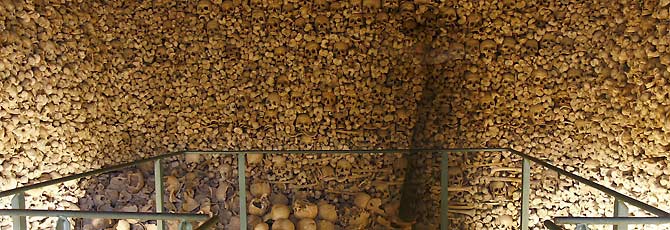
"Como te ves, yo me ví. Como me ves, te verás. Todo acaba en esto aquí. Piénsalo y no pecarás".
El pueblo de Gértico albergaba un palacio de los reyes visigodos: Allí fué proclamado rey Wamba en el año 642, dejando su nombre al pueblo como recuerdo. Es el único municipio de España cuyo nombre empieza con W. El osario es muy posterior, de los tiempos en que la Iglesia de Santa María pertenecía a la Orden de los Caballeros del Hospital de San Juan de Jerusalén, cuando comenzaron a acumularse en esa cripta los huesos de sucesivas generaciones de monjes a lo largo de cinco siglos, acompañados por la cita que sirve de pié a la foto.
Sumergido en la curiosidad por la historia de estas tierras doy con un dato completamente nuevo para mi, y es que la zona en la que yo vivo formó parte, tiempo ha, del importante Condado de Monzón que el rey de León, Ramiro II, creó para protegerse del condado de Castilla. El castillo de Monzón, desde donde se dirigía el condado, fue muy importante a lo largo de la historia. Incluso en tiempos cercanos fue el lugar donde se proclamó el Consejo General de Castilla y León, órgano encargado de redactar el Estatuto de Autonomía, en 1978. Luego ha sido hotel, restaurante y de nuevo ruina especulativa. No me puedo ir de Monzón sin señalar esta lápida, que nos habla de la inestabilidad de las viviendas de los judíos castellanos a finales del siglo XI. Prosigamos con el dato que nos lleva al siguiente salto: en el castillo de Monzón se crió Doña Urraca, y se dice en el romancero viejo:
Sobre el muro de Zamora;
vide un caballero erguido;
al real de los castellanos
da con grande grito:
—¡Guarte, guarte, rey don Sancho,
no digas que no te aviso,
que del cerco de Zamora
un traidor había salido;
llámase Vellido Dolfos,
hijo de Dolfos Vellido,
si gran traidor fue su padre,
mayor traidor es el hijo;
cuatro traiciones ha hecho,
y con ésta serán cinco!
Si te engaña, rey don Sancho,
no digas que no te aviso.
Gritos dan en el real:
A don Sancho han mal herido!
¡Muerto le ha Vellido Dolfos;
gran traición ha cometido!
Desque le tuviera muerto,
metióse por un postigo,
por las calle de Zamora
va dando voces y gritos:
—¡Tiempo era, doña Urraca,
de cumplir lo prometido!
Este Vellido Dolfos, hijo de Dolfos Vellido, es un personaje controvertido. Pero me llama la atención como es exculpado del regicidio por el leonesismo del siglo XX, dado que al parecer una figura representativa de este movimiento sostiene que el comportamiento de Dolfos en 1072 es similar al de Judit en Betulia, y por ello reúne condiciones de heroicidad.
Y así llegamos a Judit, heroica decapitadora bíblica, que tras una tarde de seducción ejecuta al general babilonio Holofernes, que estaba sitiando su ciudad.
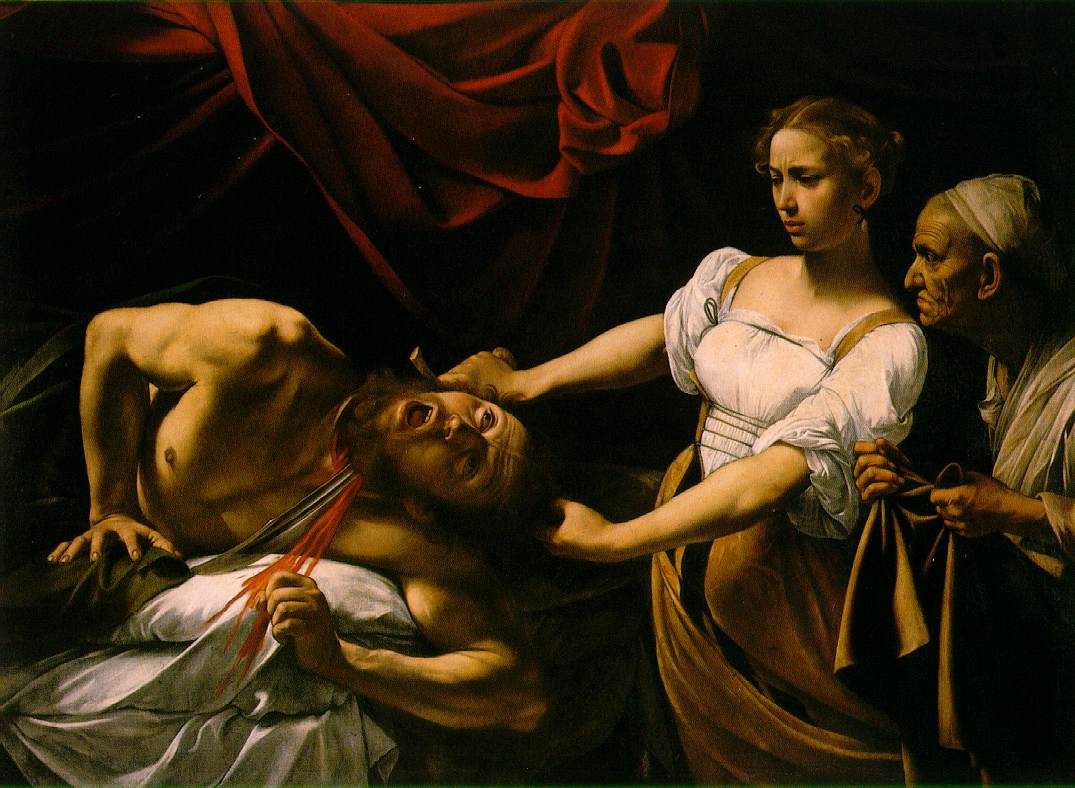
Así de gráfico lo imaginó Caravaggio. A Judit le acompaña su sirvienta, que espera pacientemente para guardar la cabeza en un saco.

Una de las inexactitudes históricas que aparece en el libro de Judit, según señala Wikipedia, está en su primer párrafo:
"El año duodécimo del reinado de Nabucodonosor, que reinó sobre los asirios en la gran ciudad de Nínive..." (Jdt 1:1) Nabucodonosor no fue rey de los asirios sino de sus enemigos los caldeos, y no reinó en Nínive sino en Babilonia. Nínive no existía ya en tiempos de Nabucodonosor, puesto que había sido destruida por su padre, Nabopolassar de Babilonia.
La urbe asiria de Nínive, junto a la actual Mosul (capital petrolífera de Irak), nació en torno a un templo a Ishtar. Según Wikipedia, la estatua de la Diosa que albergaba este templo fué expoliada por Tushratta, rey de Mitanni, quien la envió como presente al faraón egipcio Amenhotep III . Pero no fué este el último expolio que sufrió Nínive.

Henry Layard fué uno de esos infames "arqueólogos" del siglo XIX. Sus saqueos se exponen hoy en el Museo Británico.

Y la Rueda nunca, nunca se detiene: http://www.contemporania.org/monarab/SaqueadoresdelIraqdevastado.pdf
Está amaneciendo, por lo que finalizo esta sesión de exploracion irracional con el Himno a Atón, que algunos atribuyen al propio instaurador de esta deidad solar monoteísta, Akenathon, hijo de Amenhotep III y su interesante esposa real, Tiye.
- Apareces henchido de belleza en el horizonte del cielo,
- Disco viviente, que das comienzo a la Vida.
- Al alzarte sobre el horizonte de Levante
- llenas los países con tu perfección.
- Eres hermoso, grande, brillante, alto por sobre tu Universo.
- Tus rayos cubren los países hasta el confín de lo que creaste.
- Porque eres el Sol, los has conquistado hasta sus confines
- y los sujetas para tu Hijo al que amas.
- Por lejos que estés, tus rayos tocan la Tierra.
- Estás ante nuestros ojos, pero Tu camino sigue siéndonos ignoto.
- Cuando te ocultas en el horizonte de Poniente
- el Universo se sumerge en las tinieblas y queda como muerto.
- Los hombres duermen en sus moradas con la cabeza tapada
- y ninguno puede ver a su hermano.

lunes, 3 de mayo de 2010
dE rAW
Never Whistle While You're Pissing
by Hagbard Celine
by Hagbard Celine
Seventh Trip, or Netzach (the SNAFU Principle)
"The most thoroughly and relentlessly Damned, banned, excluded, condemned, forbidden, ostracized, ignore, suppressed, repressed, robbed, brutalized and defamed of all Damned Things is the individual human being. The social engineers, statistician, psychologist, sociologists, market researchers, landlords, bureaucrats, captains of industry, bankers, governors, commissars, kings and presidents are perpetually forcing this Damned Thing into carefully prepared blueprints and perpetually irritated that the Damned Thing will not fit into the slot assigned it. The theologians call it a sinner and try to reform it. The governor calls it a criminal and tries to punish it. the psychologist calls it a neurotic and tries to cure it. Still, the Damned Thing will not fit into their slots.
"The most thoroughly and relentlessly Damned, banned, excluded, condemned, forbidden, ostracized, ignore, suppressed, repressed, robbed, brutalized and defamed of all Damned Things is the individual human being. The social engineers, statistician, psychologist, sociologists, market researchers, landlords, bureaucrats, captains of industry, bankers, governors, commissars, kings and presidents are perpetually forcing this Damned Thing into carefully prepared blueprints and perpetually irritated that the Damned Thing will not fit into the slot assigned it. The theologians call it a sinner and try to reform it. The governor calls it a criminal and tries to punish it. the psychologist calls it a neurotic and tries to cure it. Still, the Damned Thing will not fit into their slots.
Appendix Teth: Hagbard's Booklet
" I once overheard two botanists arguing over a Damned Thing that had blasphemously sprouted in a college yard. One claimed that the Damned Thing was a tree and the other claimed that it was a shrub. They each had good scholary arguments, and they were still debating when I left them. The world is forever spawning Damned Things- things that are neither tree nor shrub, fish nor fowl, black nor white- and the categorical thinker can only regard the spiky and buzzing world of sensory fact as a profound insult to his card-index system of classifications. Worst of all are the facts which violate "common sense", that dreary bog of sullen prejudice and muddy inertia. The whole history of science is the odyssey of a pixilated card- indexer perpetually sailing between such Damned Things and desperately juggling his classifications to fit them in, just as the history of politics is the futile epic of a long series of attempts to line up the Damned Things and cajole them to march in regiment.
" I once overheard two botanists arguing over a Damned Thing that had blasphemously sprouted in a college yard. One claimed that the Damned Thing was a tree and the other claimed that it was a shrub. They each had good scholary arguments, and they were still debating when I left them. The world is forever spawning Damned Things- things that are neither tree nor shrub, fish nor fowl, black nor white- and the categorical thinker can only regard the spiky and buzzing world of sensory fact as a profound insult to his card-index system of classifications. Worst of all are the facts which violate "common sense", that dreary bog of sullen prejudice and muddy inertia. The whole history of science is the odyssey of a pixilated card- indexer perpetually sailing between such Damned Things and desperately juggling his classifications to fit them in, just as the history of politics is the futile epic of a long series of attempts to line up the Damned Things and cajole them to march in regiment.
Every ideology is a mental murder, a reduction of dynamic living processes to static classifications, and every classification is a Damnation, just as every inclusion is an exclusion. In a busy, buzzing universe where no two snow flakes are identical, and no two trees are identical, and no two people are identical- and, indeed, the smallest sub-atomic particle, we are assured, is not even identical with itself from one microsecond to the next- every card-index system is a delusion. "Or, to put it more charitably," as Nietzsche says, "we are all better artists than we realize." It is easy to see that label "Jew" was a Damnation in Nazi Germany, but actually the label "Jew" is a Damnation anywhere, even where anti-Semitism does not exist. "He is a Jew," "He is a doctor," and "He is a poet" mean, to the card indexing centre of the cortex, that my experience with him will be like my experience with other Jews, other doctors, and other poets. Thus, individuality is ignored when identity is asserted. At a party or any place where strangers meet, watch this mechanism in action. Behind the friendly overtures there is wariness as each person fishes for the label that will identify and Damn the other. Finally, it is revealed: "Oh, he's an advertising copywriter," "Oh, he's an engine-lathe operator." Both parties relax, for now they know how to behave, what roles to play in the game. Ninety-nine percent of each has been Damned; the other is reacting to the 1 percent that has been labeled by the card-index machine.
Certain Damnations are socially and intellectually necessary, of course. A custard pie thrown in a comedian's face is Damned by the physicist who analyzes it according to the Newtonian laws of motion. These equations tell us we want to know about the impact of the pie on the face, but nothing about the human meaning of pie-throwing. A cultural anthropologist, analyzing the social function of the comedian as shaman, court jester, and king's surrogate, explains the pie-throwing as a survival of the Feast of Fools and the killing of the king's double. This Damns the subject in another way. A psychoanalyst, finding an Oedipal castration ritual here, has performed a third Damnation, and the Marxist, seeing an outlet for the worker's repressed rage against the bosses, performs a fourth. Each Damnation has its values and uses, but is nonetheless a Damnation unless its partial and arbitrary nature is recognized. The poet, who compares the pie in the comedian's face with Decline of the West or his own lost love, commits a fifth Damnation, but in this case the game element and the whimsicality of the symbolism are safely obvious. At least, one would hope so; reading the New Critics occasionally raises doubts on this point.
Human society can be structured either according to the principle of authority or according to the principle of liberty. Authority is a static social configuration in which people act as superiors and inferiors: a sado- masochistic relationship. Liberty is a dynamic social configuration in which people act as equals: an erotic relationship. In every interaction between people, either Authority or Liberty is the dominant factor. Families, churches, lodges, clubs and corporations are either more authoritarian than libertarian or more libertarian than authoritarian. It becomes obvious as we proceed that the most pugnacious and intolerant form of authority is the State, which even today dares to assume absolutism which the church itself has long ago surrendered and to enforce obedience with the Church's old and shameful Inquisition. Every form of authoritarianism is, however, a small "State," even if it has a membership of only two. Freud's remark to the effect that the delusion of many men is religion can be generalized: The authoritarianism of one man is crime and the authoritarianism of many is State. Benjamin Tucker wrote quite accurately:
Aggression is simply another name for government. Aggression, invasion, government are interchangeable terms. The essence of government is control, or the attempt to control. He who attempts to control another is a governor, an aggressor, an invader; and the nature of such invasion is not changed, whether it be made by one man upon another man, after the manner of the ordinary criminal, or by one man upon all other men, after the manner of an absolute monarch, or by all other men upon one man, after the manner of a modern democracy.
Tucker's use of the word "invasion" is remarkably precise, considering that he wrote more than fifty years before the basic discovery of ethology. Every act of authority is, in fact, an invasion of the psychic and physical territory of another.
Every fact of science was once Damned. Every invention was considered impossible. Every discovery was a nervous shock to some orthodoxy. Every artistic innovation was denounced as fraud and folly. The entire web of culture and "progress," everything on earth that is man-made and not given to us by nature, is the concrete manifestation of some man's refusal to bow to Authority. We would own no more, know no more, and be no more than the first apelike hominids if it were not for the rebellious, the recalcitrant, and the intransigent. As Oscar Wilde truly said, "Disobedience was man's Original Virtue."
The human brain, which loves to read descriptions of itself as the universe's most marvelous organ of perception, is an even more marvelous organ of rejection. The naked facts of our economic game are easily discoverable and undeniable once stated, but conservatives- who are usually individuals who profit every day of their lives from these facts- manage to remain oblivious to them or to see them through a very rose-tinted lens. (Similarly, the revolutionary ignores the total testimony of history about the natural course of revolution, through violence, to chaos, back to the starting point.)
We must remember that thought is abstraction. In Einstein's metaphor, the relationship between a physical fact and our mental reception of that fact is not like the relationship between beef and beef-broth, a simpler extraction and condensation; rather, as Einstein goes on, it is like the relationship between our overcoat and the ticket given us when we check our overcoat. In other words, human perception involves coding even more than crude sensing. The mesh of language, or of mathematics, or of a school of art, or of any system of human abstracting, gives to our mental constructs the structure, not of the original fact, but of the symbol system into which it is coded, just as a map-maker colors a nation purple not because it is purple but because his code demands it. But every code excludes certain things, blurs other things, and overemphasizes still other things. Nijinski's celebrated leap through the window at the climax of 'Le Spectre d'une Rose' is best coded in the ballet notation system used by choreographers; verbal language falters badly in attempting to conveying; painting or sculpture could capture totally the magic of one instant, but one instant only, of it; the physicist's equation, Force = Mass X Acceleration, highlights one aspect of it missed by all these other codes, but loses everything else about it. Every perception is influenced, formed, and structured by habitual coding habits- mental game habits- of the perceiver.
All authority is a function of coding, of game rules. Men have arisen again and again armed with pitchforks to fight armies with cannon; men have also submitted docilely to the weakest and most tottery oppressors. It all depends on the extent to which coding distorts perception and conditions the physical (and mental) reflexes.
It seems at first glance that authority could not exist at all if all men were cowards or if no men were cowards, but flourishes as it does because most men are cowards and some men are thieves. Actually, the inner dynamics of cowardice and submission on the one hand and of heroism and rebellion on the other are seldom consciously realized either by the ruling class or the servile class. Submission is identified not with cowardice but with virtue, rebellion not with heroism but with evil. To the Roman slave-owners, Spartacus was not a hero and the obedient slaves were not cowards; Spartacus was a villain and the obedient slaves were virtuous. The obedient slaves believed this also. The obedient always think of themselves as virtuous rather than cowardly.
If authority implies submission, liberation implies equality; authority exist when one man obeys another, and liberty exists when men do not obey other men. Thus, to say that authority exists is to say that class and caste exis, that submission and inequality exist. To say the liberty exists is to that classlessness exists, to say that brotherhood and equality exist. Authority, by dividing men into classes, creates dichotomy, disruption, hostility, fear, disunion. Liberty, by placing men on an equal footing, creates association, amalgamation, union, security. When the relationships between men are based on authority and coercion, they are driven apart; when based on liberty and non-aggression, they are drawn together. The facts are self-evident and axiomatic. If authoritarianism did not possess the in-built, preprogrammed double-bind structure of a Game Without End, men would long ago have rejected it and embraced libertarianism. The usual pacifist complaint about war, that young men are led to death by old men who sit at home manning beaurocrats' desks and taking no risks themselves, misses the point entirely. Demands that the old should be drafted to fight their own wars, or that the leaders of the warring nations should be sent to the front lines on the first day of battle, etc., are aimed at an assumed "sense of justice" that simply does not exist. To the typical submissive citizen of authoritarian society, it is normal, obvious and "natural" that he should obey older and more dominant males, even at the risk of his life, even against his own kindred, and even in causes that are unjust or absurd.
"The Charge of the Light Brigade"- the story of a group of young males led to their death in a palpably idiotic situation and only because they obeyed a senseless order without stopping to think- has been, and remains, a popular poem, because unthinking obedience by young males to older males is the most highly prized of all conditioned reflexes within human, and hominid, societies.
The mechanism by which authority and submission are implanted in the human mind is coding of perception. That which fits into the code is accepted; all else is Damned to being ignored, brushed aside, unnoticed, and- if these fail- it is Damned to being forgotten. A worse form of Damnation is reserved for those things which cannot be ignored. These are daubed with the brain's projected prejudices until, encrusted beyond recognition, they are capable of being fitted into the system, classified, card-indexed, buried. This is what happens to every Damned Thing which is too prickly and sticky to be excommunicated entirely. As Josiah Warren remarked, "It is dangerous to understand new things too quickly." Almost always, we have not understood them. We have murdered them and mummified their corpses.
A monopoly on the means of communication may define a ruling elite more precisely than the celebrated Marxian formula of "monopoly in the means of production." Since man extends his nervous system though channels of communication like the written word, the telephone, radio, etc., he who controls these media controls part of the nervous system of every member of society. The contents of these media become part of the contents of every individual's brain.
Thus in preliterate societies taboos on spoken word are more numerous and more Draconic than at any more complex level of social organisation. With the invention of written speech -- hieroglyphic, ideographic, or alphabetical -- the taboos are shifted to this medium; there is less concern with what people say and more concern with what people write. (Some of the fist societies to achieve literacy, such as Egypt and the Mayan culture of ancient Mexico, evidentially kept a knowledge of hieroglyphs a religious secret which only the higher orders of the priestly and royal families were allowed to share.) The same process repeats endlessly: Each step forward in the technology of communication is more heavily tabooed than the earlier steps. Thus, in America today (post-Lenny Bruce), one seldom hears of convictions for spoken blasphemy or obscenity; prosecution of books still continues, but higher courts increasingly interpret the laws in a liberal fashion, and most writer feel fairly confident that they can publish virtually anything; movies are growing almost as decentralised as books, although the fight is still heated in this area; television, the newest medium, remains encased in neolithic taboo. (When the TV pundits committed le`se majeste after an address by the then Dominant Male, a certain Richard Nixon, one of his lieutenants quickly informed them they had over stepped, and the whole tribe -- except for the dissident minority -- cheered for the reassertion of tradition.) When a more efficient medium arrives, the taboos on television will decrease.
Robert Anton Wilson - The Illuminatus! Triology, escrita con Robert Shea
Investigar aquí
jueves, 25 de marzo de 2010
Palabras
"¿Como puede ser que resulte imposible decir lo que se ha visto? ¿Cómo puede ser que la verdad huya ante nuestros ojos como si no fuera verdad y que no se pueda ser sincero a pesar de serlo? Pues resulta que no se evoca una cosa cuando se la cita por su nombre... Palabras, palabras: por mucho que se las conoce desde que se es niño, no se sabe lo que son"
Henri Barbusse El Infierno
Henri Barbusse El Infierno
miércoles, 17 de febrero de 2010
El Sabor de los Leptones
(S) Extrañeza. Es un número cuántico introducido por Murray Gell-Mann.
El antiquark extraño se define para tener extrañeza +1 para con el quark Encantado. Este es un quark tipo abajo.
Un quark de un sabor dado es un estado propio de la parte de una interacción débil.
Como resultado, el sabor que contiene un estado cuántico
puede cambiar como éste se propague libremente.
De Wikipedia, la Enciclopedia Libre
El quark Encantado (también llamado a veces quark encanto o quark ch -del inglés charm quark-) es una partícula elemental que pertenece a la segunda generación de quarks. El quark encantado debe de tener una vida media corta, como los leptones de la segunda generación. La única evidencia es que forma hadrones que se desintegran pronto, pero la vida media del propio quark es muy difícil de medir debido a que se encuentra confinado.
"Lu ncantu è nu ncantìsimu, di la maggìa."
Di Wikipedia, la nciclupidìa lìbbira
lunes, 25 de enero de 2010
Intuición Pura

"De un lado, somos instuición pura, es decir, imágenes proyectadas de un ser puramente extasiado, que obtiene la suprema calma en esa intuición; de otro lado, somos el propio ser único. Por tanto, de forma totalmente real sólo somos el sufrimiento, el querer, el dolor: como representaciones no tenemos realidad, aunque sí otra clase de realidad. Si nos sentimos como el ser único, nos elevamos al instante a la esfera de la intuición pura, que carece totalmente de dolor; sin embargo somos al mismo tiempo la voluntad pura, el sufrimiento puro.
Pero, mientras nosotros mismos somos sólo "representados", no participamos de esa auscencia de dolor, mientras el que representa la disfruta exclusivamente.
En el Arte, en cambio, nos convertimos en "los que representamos": de ahí el éxtasis."
Friedrich Nietzsche
Bienvenidos a la Luz. Escribo estas líneas al amparo de un verde flexo para poneros al tanto de mis últimos e intrigantes descubrimientos. Navegando por este Universo de Representación con la sugerencia de mi socia Speaking of Happiness como única guía he dado con un mensaje etéreo: Metatrón nos ha revelado la salvación del mundo occidental a traves de la NESARA, que además de ser un género de polillas "incertae sedis", es también un proyecto secreto dirigido por cinco jueces estadounidenses para implantar una reforma económica, política y social de la que resultará la paz mundial y el fin de la pobreza a partir del místico año 2012. No olvidemos que ese es el año en que finalizará el primer mandato de Barack Obama.
El acceso a este trascendente mensaje se lo debemos a un sólo hombre... ¡No, pero que grave error de percepción! Bajo la corriente fachada de Tony, un canadiense amante de los perros, se oculta un Guerrero Índigo de la Semilla Estelar que lucha contra el sistema captando los mensajes etéreos ocultos en las películas 3D, preparando a la Humanidad para su despertar a un Nuevo Mundo en 3D en el que no habrá que pagar las hipotecas. Podeis echarle un cable mediante donativos a través de PayPal, y a cambio recibiréis su eBook, en el que desvela la conspiración crediticia orquestada por los Iluminati y el clan de los Rockefeller. Y ya sabéis quien mueve sus hilos...
No os lo toméis a risa: Metatrón sabe lo que se dice.
domingo, 24 de enero de 2010

Suscribirse a:
Entradas (Atom)


